FACTOMETER
 en
en ру
ру հյ
հյ

The latest episode of The Vovan and Lexus Show, broadcast on Russia’s state-owned Channel One, was dedicated to Armenia.
The program featured representatives of Russian state media, Russian experts and commentators known for covering Armenia’s domestic politics, many of whom have repeatedly voiced positions aligned with Kremlin policy.
The broadcast included excerpts from the prank call with the OSCE Secretary General, revisited Armenia’s 2018 Velvet Revolution, referred to a 20-year-old article by Armenian Prime Minister Nikol Pashinyan, and discussed a range of issues related to Armenia’s domestic politics.
The Fact Investigation Platform examined the program’s main claims and compared them against the available evidence. Our analysis shows that several of these claims mirror narratives that have long circulated within the Russian state information environment regarding Armenia – starting with questioning the legitimacy of the 2018 Velvet Revolution to alleging the influence of foreign actors.
It should also be noted that FIP.am has examined several economic claims made during the same program in a separate article and found that most of them are unsupported.
False Claim 1: “Large number of people took to the streets only after 23 April”
One of the guests on the program, broadcast by Russia’s leading state propaganda television channel, was ethnic Armenian Mika Badalyan, against whom Armenian law enforcement authorities have initiated criminal proceedings.
“What happened in 2018 was a transfer of power. Those rallies were a carefully staged performance on which vast sums of money were spent. … Large numbers of people took to the streets only after 23 April 2018, when Serzh Sargsyan announced his resignation. Before that, those rallies could have been dispersed and the protests eliminated within an hour,” Badalyan said.
One of the program’s hosts also likened Badalyan’s remarks to events in Ukraine: “Remember the Maidan. The demonstrations there could also have been dispersed, and we would not be facing the consequences we see today…”
Badalyan’s claim that protest rallies were limited in scale prior to 23 April 2018 is incorrect. Before Serzh Sargsyan’s resignation, between 16 and 23 April, mass demonstrations, street blockades, clashes with police and hundreds of detentions had already taken place. For example, on 17 April approximately 30,000 people had already gathered in Republic Square. By 23 April, around 1,000 citizens had been detained, including at least 55 minors. Fifty-eight people, including one minor, had been formally arrested, all of whom were released on 23 April.
On 19 April, Human Rights Watch reported that protesters had blocked government buildings, streets and bridges, while 46 people were injured during clashes on 16 April. The U.S. Department of State’s 2018 report states that police detained 1,236 individuals between 16 and 23 April. On 17 April, when Serzh Sargsyan was elected Prime Minister by the National Assembly, demonstrations and protest actions became widespread, with streets and highways blocked across the country. These documented facts demonstrate that the protest movement had already become a mass movement before 23 April.
Conclusion. Badalyan’s claim that the movement was not widespread before 23 April is not supported by the facts. Likewise, his assertion that the demonstrations could have been “dispersed within an hour” is not substantiated by the available evidence.
False Claim 2: Pashinyan’s 20-year-old article was presented without context
As the program’s participants sought to characterize Nikol Pashinyan, Mika Badalyan referred to a two-decade-old article written by the Armenian Prime Minister:
“Pashinyan is the man who said, ‘I curse our ancestors.’ He wrote this in one of his articles because, according to him, our ancestors left us nothing. He also said that animals, driven by their natural instincts, leave behind more descendants than our ancestors have done for us. They left us nothing but problems.”
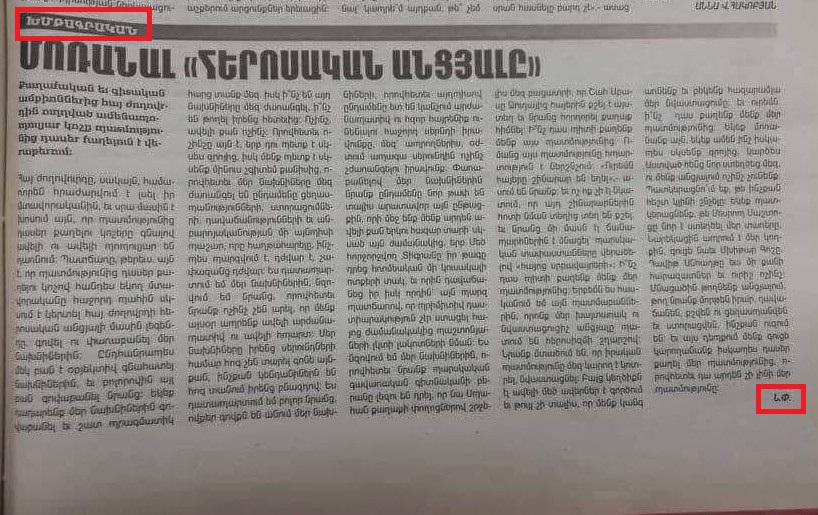
The remarks refer to the article entitled “Forgetting the ‘Heroic Past'”, published in 2005 in Haykakan Zhamanak, the newspaper then edited by Pashinyan.
Screenshot from Pashinyan’s article published in 2005
The Fact Investigation Platform located the original article. While it does indeed contain the phrase, “I curse our ancestors,” the program quoted only isolated excerpts, omitting the broader context and central argument of the article, which criticizes the idealization of Armenia’s “heroic past.”
Notably, this is not the first time that Pashinyan’s article has been used in the Russian state media to build criticism against him. In 2020, Margarita Simonyan, Editor-in-Chief of RT, published excerpts from the same article on her Facebook page, likewise presenting them without their full context. Six years later, the same article was once again cited on The Vovan and Lexus Show, broadcast by Russia’s state-owned Channel One.
Presenting the views of members of the Armenian community in Russia as the views of “Armenians”
In addition to the prank calls and studio discussions, the program featured brief street interviews (vox pops) with several members of the Armenian community living in Russia. Before introducing these interviews, one of the hosts said:
The introduction creates the impression that the views presented reflect the opinions of Armenians as a whole. However, every individual featured in the interviews criticizes Prime Minister Nikol Pashinyan, opposes Armenia’s European integration and advocates closer ties with Russia.
The program fails to present the views of Armenians holding different opinions, thereby creating a one-sided impression that the positions expressed are representative of Armenian society—or of the Armenian community at large.
Conclusion
The Fact-Checking Platform’s analysis demonstrates that a number of claims made about Armenia during the program do not withstand factual scrutiny. Some are based on factual inaccuracies, others are presented without the required context, while certain assertions are made without any supporting evidence whatsoever.
At the same time, the program reproduces long-standing narratives about Armenia that have circulated for years, including those questioning the legitimacy of the 2018 Velvet Revolution, criticizing Armenia’s European integration, and portraying Russia as Armenia’s principal strategic anchor.
These narratives have repeatedly appeared on Russian state information platforms in the past and are recognized examples of information influence operations examined within the framework of Foreign Information Manipulation and Interference (FIMI).*
* Foreign Information Manipulation and Interference (FIMI) refers to deliberate, coordinated and strategic activities carried out by foreign actors with the aim of manipulating facts, creating confusion, deepening societal polarization, undermining trust in institutions and influencing political processes.
Hasmik Hambardzumyan