FACTOMETER
 en
en ру
ру հյ
հյ

Prime Minister Nikol Pashinyan’s August 24 statement about the possibility of formally applying for EU membership drew sharp reactions from Russia’s official and media circles.
On August 24, while presenting the government’s 2026–2031 program to the National Assembly, Pashinyan spoke about ptoential EU membership and noted that it would be a lengthy process: “Armenia must first submit a formal application to join the European Union. This, too, is a process requiring extensive work, and in the near future we may well begin this process, particularly by heeding the calls of our partners in the Eurasian Economic Union.”
Within hours of the statement, senior Russian officials and Kremlin-aligned media outlets began predicting a “fatal outcome” for Armenia, warning that the country would lose Russia’s “gifts,” and that Armenia would never join the EU.
The following day, on Russian television channel NTV, Armenia’s European orientation was linked to joining the “Ottoman Empire” and the end to Armenia’s statehood.
Fact Investigation Platform examined how, following Pashinyan’s statement, a narrative portraying Armenia’s European orientation as a threat to its economy, security and statehood emerged and intensified in Russian official and media circles, and how its key messages were reproduced in the Armenian media.
What did Pashinyan actually say?
In his August 24 speech, Nikol Pashinyan said that Armenia’s partnership agenda with the European Union is implemented at a “visible pace.” He referred to the law adopted in 2025 on launching the process of EU accession, the first Armenia-EU summit, and the government’s goal of achieving visa liberalization by 2029.
However, Pashinyan did not say that Armenia has already submitted a formal application for EU membership or that it is preparing to immediately leave the Eurasian Economic Union. According to Pashinyan, Armenia must first prepare and submit the application, receive a response from the EU and obtain a roadmap for the process; only then would a referendum on EU membership become meaningful.
Addressing the EAEU, Pashinyan said that the restrictions imposed by Russia on Armenian goods were contrary to the Union’s regulations. At the same time, he welcomed statements by the leaders of the four other EAEU member states regarding the need for Armenia to hold a referendum on EU membership or remaining in the EAEU.
Thus, Pashinyan referred to a lengthy process whose outcome remains uncertain, as well as the need to diversify Armenia’s external economic ties. In Russian circles, however, the discussion was largely presented as Armenia’s final break with Russia.
Stage 1: “The EU Is unattainable, and the outcome will be fatal”
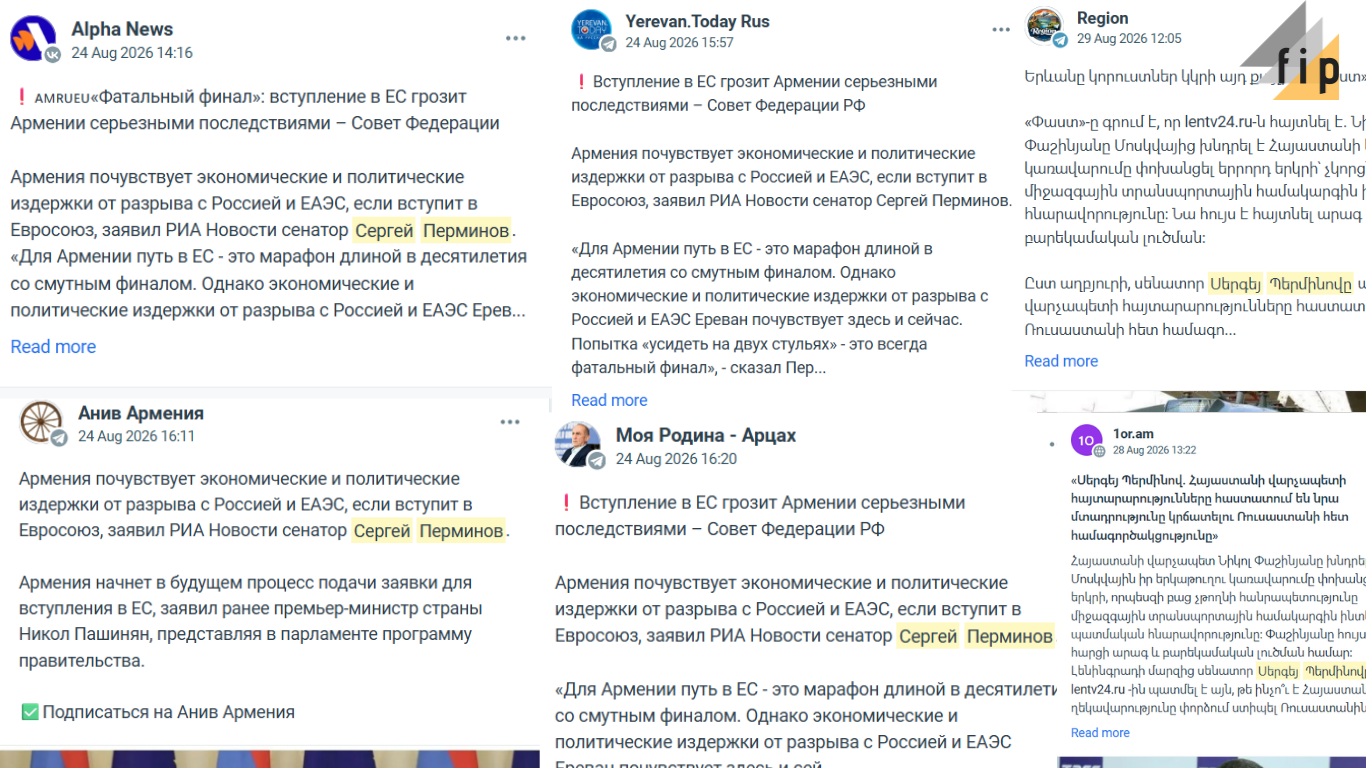
“EU membership is a marathon lasting decades”; “Armenia will immediately face the negative consequences of distancing itself from the EAEU and Russia”; and “trying to sit on two chairs never ends well” — comments along these lines were made in Russia following Pashinyan’s statement. These remarks by Russian Senator Sergey Perminov were immediately taken by Armenian media outlets.
Pashinyan was then mentioned that same day by Dmitry Medvedev, Deputy Chairman of Russia’s Security Council, who declared: “Armenia will never join the EU, but it will ruin its relations with Russia and the EAEU.”
Most of the Armenian media outlets referred to Medvedev’s political projection in the headlines of their articles. The publications were largely limited to relaying his remarks and did not clarify that Armenia has not yet submitted a formal application, and that there is no decision to withdraw from the EAEU.
Thus, Russian officials presented the still-uncertain prospect of EU membership as a predetermined “fatal outcome” for Armenia.
Armenian media outlets also reproduced Medvedev’s insulting remark directed at the government of Armenia.
Stage 2: Threats to take back the “gifts and privileges”
The following day, August 25, a threat was issued from Russia that all the “gifts and privileges” would be taken back if Yerevan “flirted” with Europe. This time, the statement came from Russian State Duma deputy Alexey Chepa. He also said that Yerevan could not sit on two chairs at the same time.
The Russian lawmaker’s remarks contain an explicit threat of punishing Armenia. In this framing, economic relations between Armenia and Russia are presented as a system of one-sided “gifts” bestowed upon Armenia by Russia, while mutual agreements and interests are ignored. According to this narrative, Moscow can withdraw these “gifts” because of Yerevan’s political choices.
The same day, Russian newspaper Izvestia developed the narrative of economic collapse by describing what Armenia’s possible future could look like if it joined the EU. The authors of the article concluded that the economic cost of leaving the EAEU and moving toward the EU could be excessively high for Armenia. According to the analysis, full EU membership could take decades, while low export figures, the EU’s limited capacity and prioritizing Ukraine in terms of financial assistance could lead to a decline in living standards in Armenia.
This analysis was reproduced in full by Armenian media outlets (1, 2).
Stage 3: The narrative of the end to Armenian statehood
The main Russian propaganda narratives were also used on August 25 during the NTV program Mesto vstrechi, under the title “Euro-Mutation.”
Note that NTV is one of the Kremlin’s largest propaganda outlets and is fully controlled by the state-owned Gazprom-Media Holding.
The design of the program’s studio is noteworthy: the speakers were seated in a circle, while in the middle, on the floor, was a map of Armenia surrounded by barbed wire.
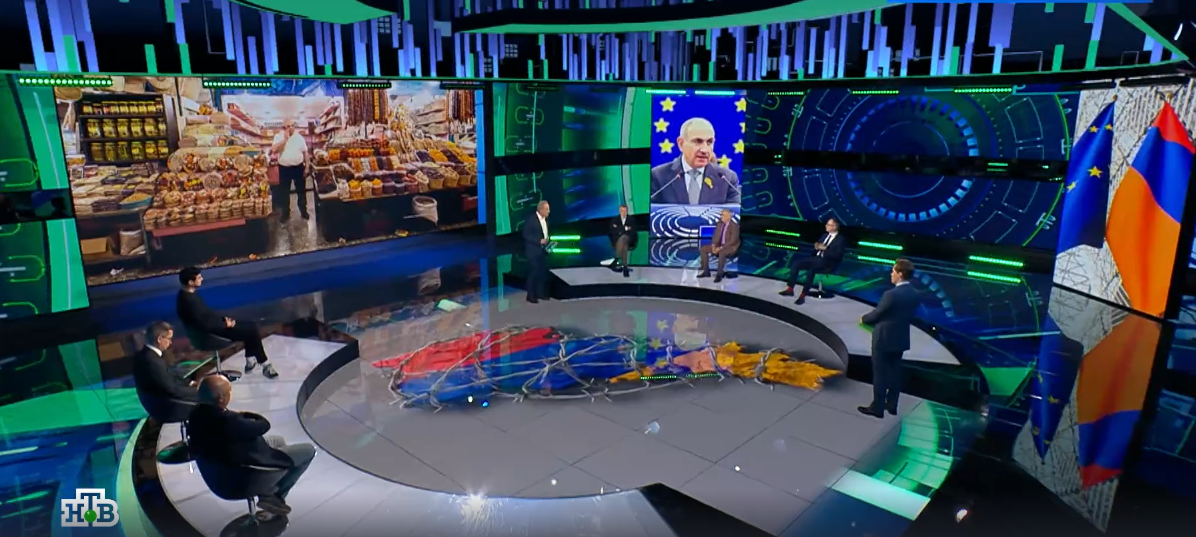
During the program, the hosts referred to the fact that Yerevan has officially declared a course toward EU membership, quoted Pashinyan’s statements and discussed farmers’ grievances. The program hosts posed the following sarcastic question: “Why are Armenian farmers closing the country’s roads out of joy?”
One of the guests, journalist Andrey Sidorchik, advanced the claim that without Russia, Armenia would end up in the “Ottoman Empire”: “No matter how much they tell Armenia that it is going to enter some kind of blooming garden, the only place Armenia can enter without Russia is the Ottoman Empire. Of course, Armenia can be used to inflict serious damage on Russia. But the problem is that this damage will result exclusively in the elimination of the concept of ‘Armenian statehood.’”
Sidorchik’s formulation is not new to Armenian political discourse. Representatives of the Strong Armenia party and the Armenia Alliance have also promoted the narrative that if Armenia does not maintain allied relations with Russia, it will fall under Turkey’s influence. Robert Kocharyan even warned from prison: “This must be stopped, or everyone should start learning Turkish.”
Thus, within a single day, the narrative moved from projections of economic losses and Armenia’s failure to join the EU to a threat to the country’s very physical existence. The reference to the “Ottoman Empire” also sought to tap into historical trauma in Armenian society by linking closer ties with the EU to Turkish control and the loss of statehood.
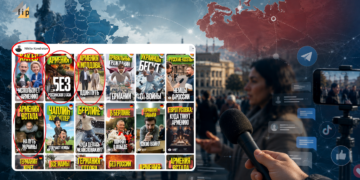
The same narrative, using virtually identical formulations, was circulated through Armenian pro-Russian Telegram channels (1, 2).
Stage 4: Official endorsement and the “Ukrainian scenario”
On August 27, the narrative was picked up by Maria Zakharova, spokesperson for Russia’s Foreign Ministry. During a briefing, she stated that Armenia was trying to obtain the benefits of EU membership without giving up the “privileges” it enjoys within the EAEU, describing Yerevan’s approach as “indecent.” Armenian media outlets also reproduced these remarks (1, 2, 3).
On August 28, the increasingly circulated narrative about the “Ukrainian path” appeared in Armenian coverage of an interview given by Russian Foreign Minister Sergey Lavrov. In this case, however, the Armenian media outlet’s headline was stronger than Lavrov’s actual remarks in the original source.
In an interview with RBK, it was the journalist who drew a parallel with Ukraine, asking how Russia could avoid repeating the mistakes it made in its relations with Ukraine in the case of Armenia. Lavrov did not say that Armenia would follow Ukraine’s path. He responded that the Russian side has done everything possible, then spoke about the economic benefits Armenia receives from EAEU membership and the need to address disagreements through dialogue.
Meanwhile, some Armenian media outlets attributed the comparison with Ukraine directly to the Russian foreign minister and presented it as a warning to Armenia (1, 2).
Thus, Pashinyan’s August 24 statement did not create a new narrative. Instead, it provided an opportunity to reactivate and intensify an already circulating discourse of threat. Within a matter of days, the cautious statement about the possibility of submitting an EU membership application was transformed in Russian official and media circles into predictions of inevitable economic punishment, a security crisis and the end to Armenia’s statehood.
At the core of these messages is the same false dilemma: either Armenia remains under Russia’s influence, or it loses its economy, security and statehood. Within this framework, Russia is portrayed as the sole guarantor of Armenia’s existence, while an independent foreign-policy choice is presented as a path toward the “Ottoman Empire” or a “Ukrainian scenario.”
Armenian media outlets have not played merely the role of neutral transmitters in this chain. Some outlets highlighted Russian officials’ political projections in their headlines without presenting the conditional nature of Pashinyan’s remarks. Meanwhile, claims that without Russia Armenia would become a “Turkish vilayet” and a second Ukraine, have also been repeatedly echoed by Armenian opposition figures.
As a result, the Russian threat narrative has not simply been translated and disseminated within Armenia’s information domain; it has also been blended with local political discourse. The genuine economic and political debate surrounding the EU-EAEU relationship has been replaced by a formula built on the concept of fear: either Russia, or the disappearance of Armenia from the world map.
Hasmik Hambardzumyan