FACTOMETER
 en
en ру
ру հյ
հյ

Russian State Duma deputy Viktor Vodolatsky, in an interview with TASS, claimed that “at least 20 percent of the votes were stolen from the opposition in Armenia.”
He also stated that observers had recorded “electoral carousels, ballot removal, open voting, as well as group voting by military personnel.”
“Large-scale fraud took place in Armenia. Representatives of all organizations and parties opposed to Pashinyan were arrested. Everything was done to ensure that ballots cast in favor of these forces were either destroyed or invalidated. Naturally, during the vote count, the data recorded in electoral commission protocols were presented as votes cast for Pashinyan’s Civil Contract party. At least 20 percent was stolen from the opposition,” the Russian lawmaker declared.
His statement was circulated by several Russian media outlets (1, 2, 3), as well as Armenian media organizations including Yerevan.today, Sputnik Armenia, Aravot, Hraparak, and several others (1, 2).
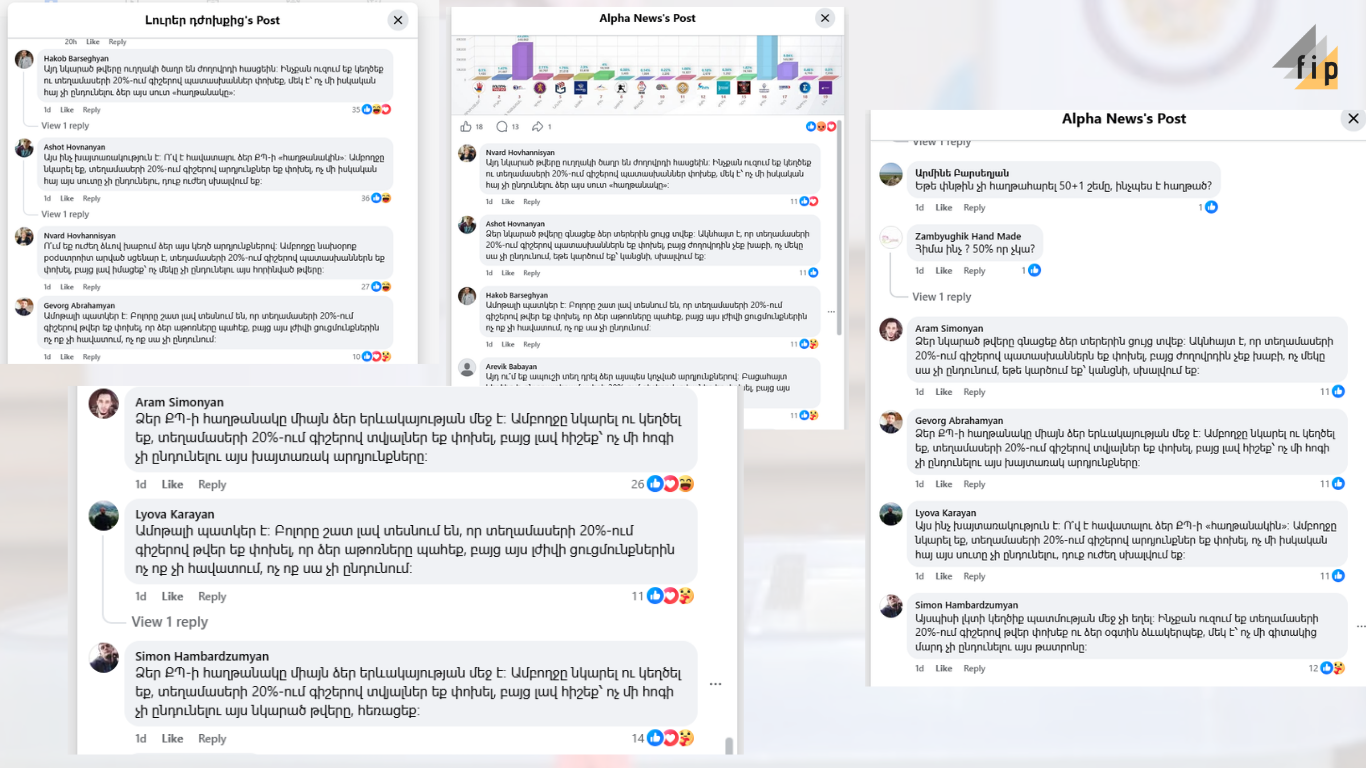
The claim that at least 20 percent of the opposition’s votes had allegedly been stolen in Armenia’s elections began circulating yesterday. However, it did not originate from election observers who monitored the parliamentary elections or from the opposition itself, but rather from Facebook accounts.
Specifically, in the comments sections of publications by various media outlets and accounts on Facebook (1, 2, 3, 4), dozens of users claimed that the election results did not reflect the actual vote because “at least 20 percent of the opposition’s votes had been stolen.”
A significant number of the comments repeated the same figures, conclusions, and often identical or highly similar wording, referring to the “stolen 20 percent,” “falsified results,” and the “real winner.”
For example, user Lilia Chilingaryan wrote:
“Who are you trying to fool with these false results? The whole scenario was pre-arranged. You changed the data overnight in 20 percent of the polling stations, but know this well: no one is going to accept these fabricated numbers.”
The same comment, with identical content, appeared under two separate news articles (1, 2). An examination of the user’s Facebook profile showed that she actively shares live broadcasts and interviews featuring Narek Karapetyan, a representative of the Strong Armenia party.
Another user, Hermine Xanagyan, whose profile photo depicts a model of Turkish ethnicity, wrote:
“Who exactly do you think you are fooling with these so-called results? This is blatant fraud. You changed the data overnight in 20 percent of the polling stations, but these fabricated figures will eventually come to light. No one accepts this.”
Some of the Facebook accounts that have been promoting the claim since yesterday that 20 percent of the votes were allegedly stolen were created in September–October 2025, have only a few friends, are not particularly active on social media, yet regularly share materials and videos related to Strong Armenia.
Thus, the claim that “20 percent of the votes were stolen” first gained broad circulation in social media comment sections, then appeared in a statement by a Russian political figure, after which it was republished and disseminated by certain Russian and Armenian media outlets.
This example resembles a process of information narrative reinforcement, whereby the same claim, through repeated reproduction, gains the opportunity to enter the public agenda regardless of its factual basis.
The claim that “20 Percent of the votes were stolen” is not substantiated
Organizations that conducted election observation missions during Armenia’s parliamentary elections did not report of “20 percent stolen votes” in their findings.
For example, at a press conference on June 8, the observer mission of the Commonwealth of Independent States (CIS) stated that:
“The elections to the National Assembly of the Republic of Armenia were conducted in accordance with the Constitution and the Electoral Code and were multiparty, open, and competitive.”
A largely similar assessment was also issued by the OSCE/ODIHR observation mission, which noted that the elections were competitive, voters were offered a range of genuine political alternatives, and fundamental freedoms were generally respected throughout the electoral process. At the same time, the mission recorded certain organizational and procedural shortcomings but did not report systemic fraud that decisively affected the election results, nor did it mention any alleged theft of “20 percent of the votes.”
Notably, the figure of “20 percent” appears neither in the published assessments of observation missions nor in the official election protocols.
Instead, it circulated widely on social media and later appeared in statements by a Russian official and in publications by a number of media outlets.
Hasmik Hambardzumyan