FACTOMETER
 en
en ру
ру հյ
հյ

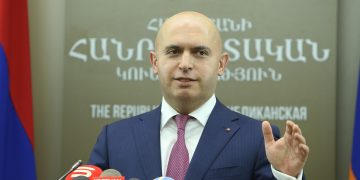
Ahead of the parliamentary elections in Armenia, a delegation from a newly created initiative called the International Observatory for Democracy in Armenia (IODA) was in Yerevan, with an announced goal of assessing the state of democracy in the country ahead of the elections.
IODA was established recently, conducting its first fact-finding mission on March 7-12. Following the results of the mission, members of the delegation recently held a press conference in Yerevan, during which inaccurate statements were made.
The Fact Investigation Platform has examined the statements of the delegation members and the activities of the initiative.
Information about Karapetyan was incomplete
At the press conference, mission member Sarah Lee Winston did not provide a full account of the charges against the leader of the Strong Armenia party, Samvel Karapetyan. “At the moment, Samvel Karapetyan, the leader of one of the most prominent political parties remains under house arrest, and it is very difficult to imagine that a fair election can take place when the head of a political party has been charged with a speech-related offense and remains under arrest,” Winston said.
However, the reality is different. In addition to the charge of “public calls to seize power,” he has also been charged with money laundering (Article 296, Part 3, Paragraphs 2 and 3 of the Criminal Code of the Republic of Armenia).
Moreover, Karapetyan was arrested back in the summer of 2025, when he was not the leader of any party. The creation of the “Strong Armenia” party was announced only in February 2026.
Thus, at the time of his arrest, he was not leader of any political party.
Statements outside the scope of the mandate
The members of the delegation announced at the beginning of the press conference that the purpose of their mission was to assess the electoral environment in Armenia.
However, later they also referred to Armenian detainees held in Azerbaijan and made assessments of the actions of the Armenian government. “In reality, the Armenian government is not taking any action to demand the release of these prisoners. In fact, this is a drama, a national tragedy,” said delegation member Philippe Raffi Kalfayan. At the same time, they noted that this topic was beyond the mandate of their mission.
However, Kalfayan’s assessment contradicts the public statements of the Armenian government.
Prime Minister Nikol Pashinyan recently stated in the European Parliament that Armenia is trying to achieve the return of the detainees through diplomatic work.
In his recent interview with Public Television, he mentioned that the question of Armenians held in Baku was raised as early as August 8 during Armenia-United States talks. “The issue was on the agenda and was discussed. In practice, there is no relevant negotiation in which we do not address this issue,” Pashinyan said.
In addition, on January 14, 2026, four prisoners held in Azerbaijan were returned to Armenia.
Who did IODA representatives meet with?
IODA announced that it met with “a wide range of actors.” However, the information published by the initiative shows that they met with MPs from only one parliamentary faction, the “Armenia” faction, and the Human Rights Defender, as well as members of the Supreme Judicial Council. There is no information on other meetings.
There is no information about a meeting between representatives of the government and the ruling party, as well as representatives of civil society, although, according to their statements, they made attempts to meet with both members of the ruling party and representatives of civil society.
According to previously released information, the delegation members planned to meet with representatives of the Armenian Apostolic Church, media, as well as representatives of the US, UK, and Russian embassies in Armenia.
IODA and Armenian elections
IODA was established quite recently, and the occasion is the Armenian elections. The founder of the initiative is French Armenian lawyer Philippe Raffi Kalfayan. The latter is an expert in international law, and previously served as the Secretary General of the International Federation for Human Rights (FIDH). He is now an active columnist in the Armenian Diaspora press and publishes political articles about Armenia. In these articles, he exclusively criticizes the Armenian government.
He has gathered around him a number of international experts. The organization is not a formally registered international organization.
It is officially presented as an independent international initiative that is supposed to “observe and analyze Armenia’s democratic processes, civic space, and the development of political institutions.”
The IODA website states that at this stage, the initiative’s current activities are funded by the Armenian Legal Center for Justice and Human Rights (ALC). According to the source, the members of the initiative contribute voluntarily and are not compensated for their time or expertise.
By the way, the domain registration data for the official website of this initiative shows that it was created only recently, in January 2026, that is, shortly before the Yerevan press conference.
IODA funding and Armenian National Committee organizations
The initiative announced that the initial funding for its activities was provided by the Armenian Legal Center for Justice and Human Rights (ALC).
ALC was founded in 2016 in Washington and is engaged in international legal initiatives.
It is noteworthy that the organization was created with the financial support of the ANCA Endowment Fund. This fund is directly linked with one of the most famous Armenian lobbying organizations in the United States, the Armenian National Committee of America (ANCA). ANCA has ties to the Armenian Revolutionary Federation, with most representatives being its members.
The ALC chairman is Ken Khachigian, who was previously the chairman of the ANCA National Council, and prominent ARF member Kiro Manoyan, one of the ALC’s leading figures, is a board member. Kiro Manoyan has shared the results of the IODA report on his Facebook page.
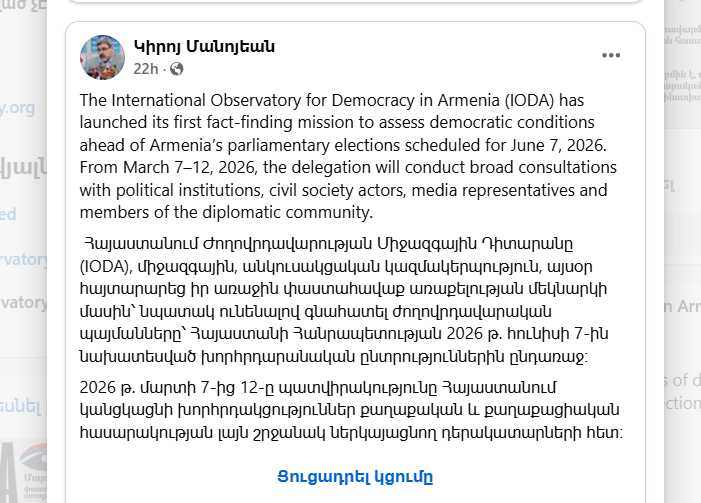
Thus, the data shows that the leadership of the ALC, which funds IODA, has direct ties to the ARF-ANCA political network.
By the way, most of the experts who are members of this initiative work in France, the USA, and Canada, that is, in places where the Armenian Diaspora is large and the Armenian National Committee offices are active.
Note that the local representative of IODA in Armenia, who organized these expert meetings, was the assistant to Lilit Galstyan, an MP from Armenia faction, who actively shared IODA’s statements on Facebook.
Narratives in the media following IODA press conference
After the statements made by IODA during the press conference, three narratives about the political environment in Armenia began to circulate in the media:
- There is a decline in democracy in Armenia, political persecution of the opposition is practiced, and the judicial system is used against the opposition.
- There is interference in elections by foreign forces, US support for certain political parties.
- The policy of the Armenian government aligns with Turkey’s interests.
These narratives have been widely circulated, despite the fact that IODA is a newly founded organization, funded by specific actors in the Diaspora, and the fact that it had meetings with a very limited scope of stakeholders in Armenia.
Thus, the International Observatory for Democracy in Armenia (IODA) initiative is newly created, is not a formally registered international organization, and is funded through diaspora organizations that have political ties to the ARF-ANCA network. During its first visit to Armenia, the delegation members met with a limited number of Armenian representatives.
A number of statements made by members of the delegation at the press conference included incomplete or false information and were beyond the official mandate of IODA. The organization’s members were mainly focused on criticizing the Armenian government. The narratives circulating in the media after the press conference were not based on complete information.
Hasmik Hambardzumyan