FACTOMETER
 en
en ру
ру հյ
հյ

*Update 15.04.2026․ After publishing this article, it was revealed that the same “Rouslan” had also sought contacts in Armenia. LGBT rights activist Mamikon Hovsepyan told the Fact Investigation Platform that a user named Rouslan contacted him via Instagram, and made the same offer as to the Moldovan blogger.
“The idea is to express support for Pashinyan. You can say a few words and make his trendy ‘hand-heart’ gesture,” Rouslan suggested to Mamikon.
In recent days, several representatives of civil society in Moldova have received a message from an individual named “Ruslan,” who claimed he was looking for bloggers to travel to Yerevan for 3–4 days to produce content. According to the message, Ruslan would cover all expenses related to their stay in Yerevan.
“My name is Ruslan, I am a manager at an advertising agency. We represent an initiative that supports Armenia’s political line of course toward Europe. The task is simple and important: to publicly address Pashinyan from Yerevan, calling on him to uphold minority rights and support the organization of a march as a sign of solidarity with Europe, as well as to support European integration,” the message reads.
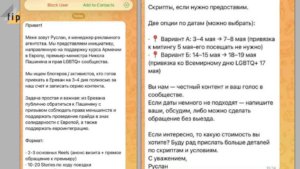
The Fact Investigation Platform received screenshots of these messages from Moldovan partners and attempted to determine who might be behind the initiative.
The Suspicious Message
The message was initially received by a representative of Moldova’s LGBT+ community, who then shared it with civil society actors. It was sent via Telegram and is highly likely to be a scam. The individual identifying himself as Ruslan claims to be a manager at an advertising agency but does not specify the agency’s name, which already raises concerns. Furthermore, no surname is provided. It is reasonable to assume that reputable marketing companies do not approach individuals with such politically sensitive proposals via unsolicited Telegram messages without prior formal contact.
The message immediately introduces references to Armenia’s “political line of course,” discussing the country’s pro-European direction and raising issues related to the LGBT community—effectively blending sensitive social topics with political messaging.
It further states that the blogger’s travel and accommodation expenses in Armenia would be covered for several days, with the proposed visit timed either around the European Political Community summit scheduled in Yerevan on May 4, or around May 17, the International Day Against Homophobia.
Notably, “Ruslan” also appears to script the content for the alleged blogger visiting Yerevan, specifying that it should include an appeal to the Prime Minister and support for European integration.
Another striking detail is the choice of Moldovan bloggers. The rationale appears clear: Armenian bloggers could be more easily identified, whereas a foreign blogger—portrayed as someone who has “come specifically in solidarity with Europe”—could serve as a “useful tool” in the hands of disinformation actors to promote the narrative that Europe is bringing in outsiders to “change Armenia’s values.”
Nevertheless, FIP.am attempted to contact “Ruslan,” but his phone number is unavailable, and messages sent to his Telegram account have not been delivered.
Lessons from Moldova
Such methods are not new. In the run-up to elections, similar tactics are often used to influence electoral processes and shape public perceptions. In Moldova, for instance, numerous cases of fake and manipulative messages were documented during the pre-election period.
These types of messages can also be viewed as examples of Foreign Information Manipulation and Interference (FIMI)—when external actors attempt to influence public discourse, perceptions, and even political processes in a given country (in this case, Armenia) through manipulative content, fabricated initiatives, or misleading communications.
Moreover, such methods can contribute to societal polarization and foster the false perception that certain ideas are being imposed from outside.
In this case, “Ruslan” appears to have attempted to recruit foreign bloggers to disseminate a message aligned with his agenda—one that touches on issues particularly sensitive for Armenian society.
“Those exerting foreign interference in Moldova resorted to direct messaging deception—sending fraudulent emails, distributing fake official letters, and conducting SMS campaigns related to elections,” security policy expert Andrei Curararu, a representative of the Watchdog MD organization, told FIP.am.
Ahead of Moldova’s October 2024 presidential elections and the referendum on EU membership, state institutions, companies, schools, local self-government bodies, and civil servants received fake documents, messages, or letters via email.
For example, one such forged letter addressed to the Ministry of Labor claimed that the Moldovan government planned to relocate migrants from the Middle East to Moldova and instructed employers to reserve jobs for them.
A fake message sent to the Ministry of Education informed schools and universities that they would need to introduce additional sex education courses and gender-neutral bathrooms.
A message addressed to the Ministry of Agriculture stated that the European Union had refused to support Moldovan farmers.
A fabricated document allegedly from an EU partnership mission claimed that Moldova’s accession to the EU would require Moldovan men aged 18–45 to join military operations in Ukraine and form a volunteer corps.
Municipalities and civil society organizations in various Moldovan cities also received a fake letter alleging that waste imported from Romania and Ukraine would be burned in Moldova.
It is worth noting that within the framework of a disinformation campaign targeting Armenia, a similar narrative was circulated about the country, claiming that French nuclear waste would allegedly be stored in Armenia.
According to Andrei, each letter or document was drafted in appropriate administrative language to avoid raising suspicion.
However, ahead of the 2025 parliamentary elections, the tactics shifted, and actors engaged in Foreign Information Manipulation and Interference (FIMI) began using mobile messaging campaigns.
“During the parliamentary election campaign, citizens reported receiving SMS messages allegedly sent on behalf of PAS (the ruling party), promising money in exchange for photos of completed ballots. This was significant because it targeted a critical element of the electoral process. Although such claims were quickly debunked, the content nonetheless injected doubt into the public ahead of voting,” the Moldovan expert noted.
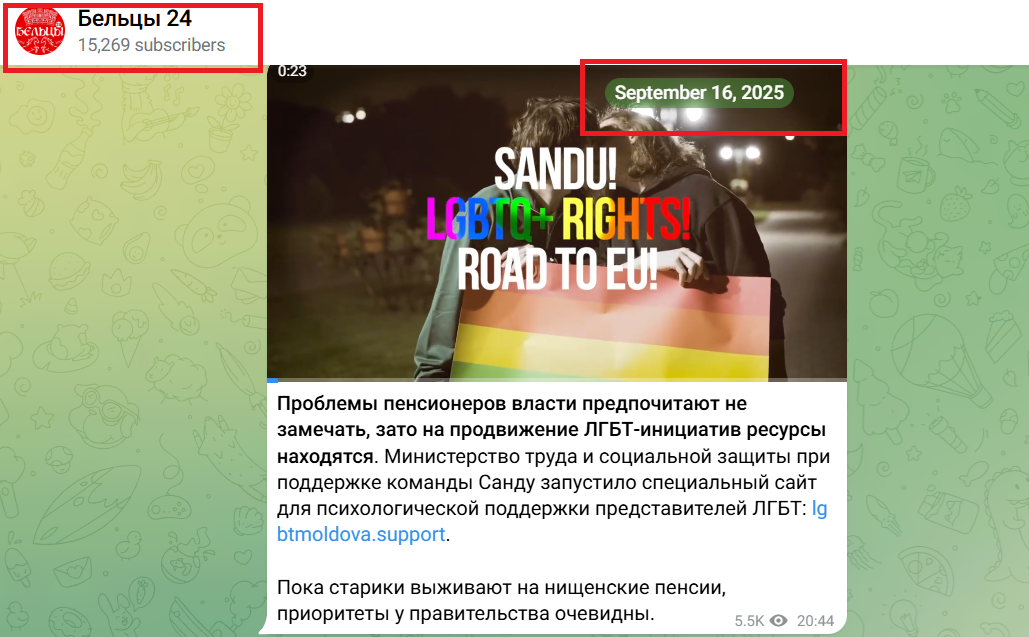
A few days before the parliamentary elections, a Telegram channel from Bălți published a video featuring representatives of the LGBT community thanking Moldovan President Maia Sandu. The caption, however, criticized the authorities for neglecting pensioners’ issues while allocating resources to promote LGBT initiatives.
Thus, it is important to keep caution and avoid responding to messages that
- do not include an official website or corporate email address
- offer financial compensation in exchange for political content
- contain pre-scripted or imposed messaging
- are limited to communication via messaging apps only (in this case, Telegram).
Read also: Another false claim by a Turkish author against Armenia published in China’s state media
Hasmik Hambardzumyan