FACTOMETER
 en
en ру
ру հյ
հյ
The Fact Investigation Platform has obtained a number of documents concerning Samvel Karapetyan, which it considers necessary to present to the public.
The documents contain extensive information gathered about businessman Samvel Sargis (patronymic) Karapetyan, including details of his professional activities in Russia.
They feature information about the establishment of his business empire, ownership shares in various companies, and management roles. The sources also detail his assets, including real estate holdings in Moscow, records of luxury purchases, and bank deposits.
The documents also contain additional data which we compared with information already at our disposal.
The editorial team has chosen not to publish certain additional information obtained, in accordance with ethical standards governing the protection of personal data. Only information assessed by the editors to be of substantial public interest is being disclosed. In this case, the public interest arises not from observation of Samvel Karapetyan’s private life, but from his legal status as a major businessman and influential public figure engaged in political processes.
Until Armenia’s 2005 constitutional amendments and the legislative reforms in 2007, dual citizenship was prohibited under Armenia’s Constitutional framework. It is therefore of public importance to determine whether a public figure during that period may have been in conflict with those legal provisions. The purpose of this publication is not to disclose details of private life, but to shed light on legal and political circumstances of public significance, based on documents and data reviewed by the editorial team.
Russian citizenship incompatible with Armenian citizenship
One issue that came to the attention of FIP.am in the documents was Samvel Karapetyan’s citizenship status: throughout the records, he is consistently described as a citizen of the Russian Federation. But when did he become a Russian citizen?
The documents contain references to Karapetyan’s naturalization to the Russian Federation (“ПРИНЯТО ГР-ВО РФ” — “Acquired nationality of the Russian Federation”), dated 1993 and 1996.
According to the same documents, Karapetyan acquired Armenian citizenship in May 1993.
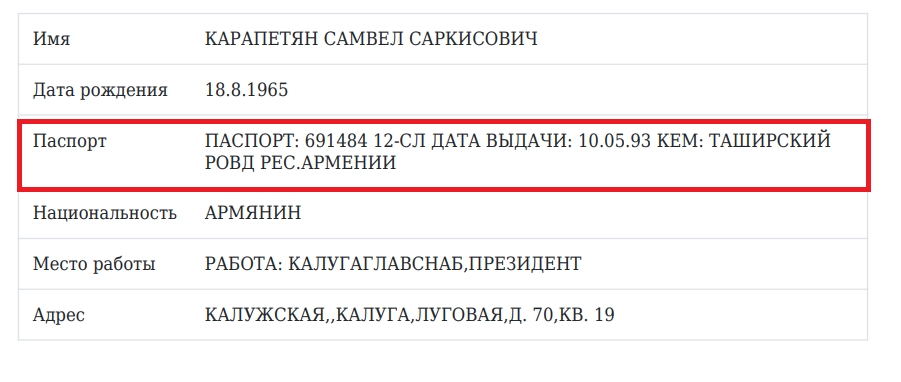
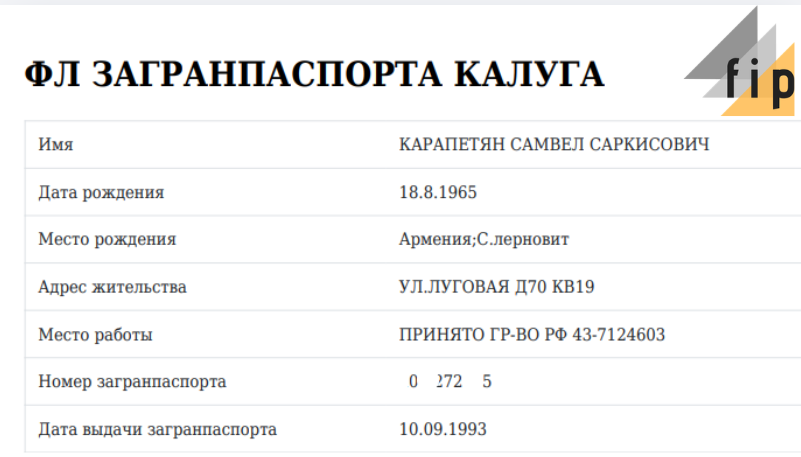
Several months later, in September, he began processing Russian citizenship documents and received a foreign passport. Specifically, the Kaluga region’s foreign passport database contains an entry showing that a foreign passport was issued to him on September 10, 1993. Notably, the “Place of Work” field in that entry includes the administrative notation “ПРИНЯТО ГР-ВО РФ” (“acquired nationality of the Russian Federation”). This suggests that he either obtained Russian citizenship during that period or was officially documented on that basis.
According to the same documents, on June 19, 1998, Karapetyan was issued an internal Russian passport (series 29 97 No. 020017) by the October District Department of Internal Affairs in Kaluga. The passport database states that the document was issued due to an “exchange of USSR passport” (“ОБМЕН ПАСПОРТА СССР”). This indicates that in 1998 he formally re-registered his status as a Russian citizen by replacing a Soviet passport with an internal passport of the Russian Federation.
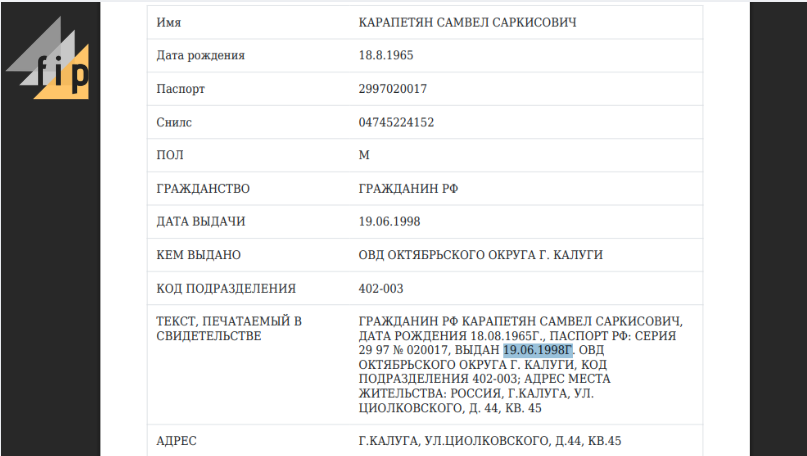
Thus, 1993 appears to mark the initial phase of Karapetyan’s acquisition of Russian citizenship, while 1998 was the year in which he was formally documented with an internal Russian passport.
It should also be noted that Karapetyan holds Cypriot citizenship as well, although the documents available to us contain no information about it. They are focused exclusively on his Russian documents, Russian-registered property, businesses, and financial data.
Karapetyan violated the Constitution
Article 14 of Armenia’s 1995 Constitution and Article 1 of the 1995 Law on Citizenship stated: “A citizen of the Republic of Armenia may not simultaneously hold citizenship of another state.”
According to the aforementioned documents, Karapetyan possessed both an Armenian passport and Russian citizenship from 1993 onward. Therefore, his status between 1995 and 2005 was in conflict with Armenia’s Constitution at the time, since the ban on dual citizenship was lifted only after the constitutional amendments of 2005 and was legally regulated only in 2007 through amendments to the Law on Citizenship.
In other words, until then, an Armenian citizen was legally banned from simultaneously holding citizenship of another country.
However, the later amendments also retroactively legalized the status of individuals who, after January 1, 1995, had acquired another country’s citizenship without formally renouncing Armenian citizenship.
The revised legislation further established that acquiring another citizenship does not in itself constitute ground to lose Armenian citizenship.
Therefore, although Karapetyan’s dual citizenship contradicted Armenia’s Constitution between 1995 and 2005, the legislative amendments adopted in 2007 retroactively legalized the status of such individuals.
Under current law, he is considered a dual citizen of Armenia, and as for Armenia he is recognized solely as an Armenian citizen unless he has officially renounced that citizenship.
Narek Karapetyan is mistaken
The documents available to FIP.am also contain information indicating that Samvel Karapetyan’s workplace was listed as the “Information Center of the FSB.” Russian outlet The Insider published an extensive article on the matter on May 19.
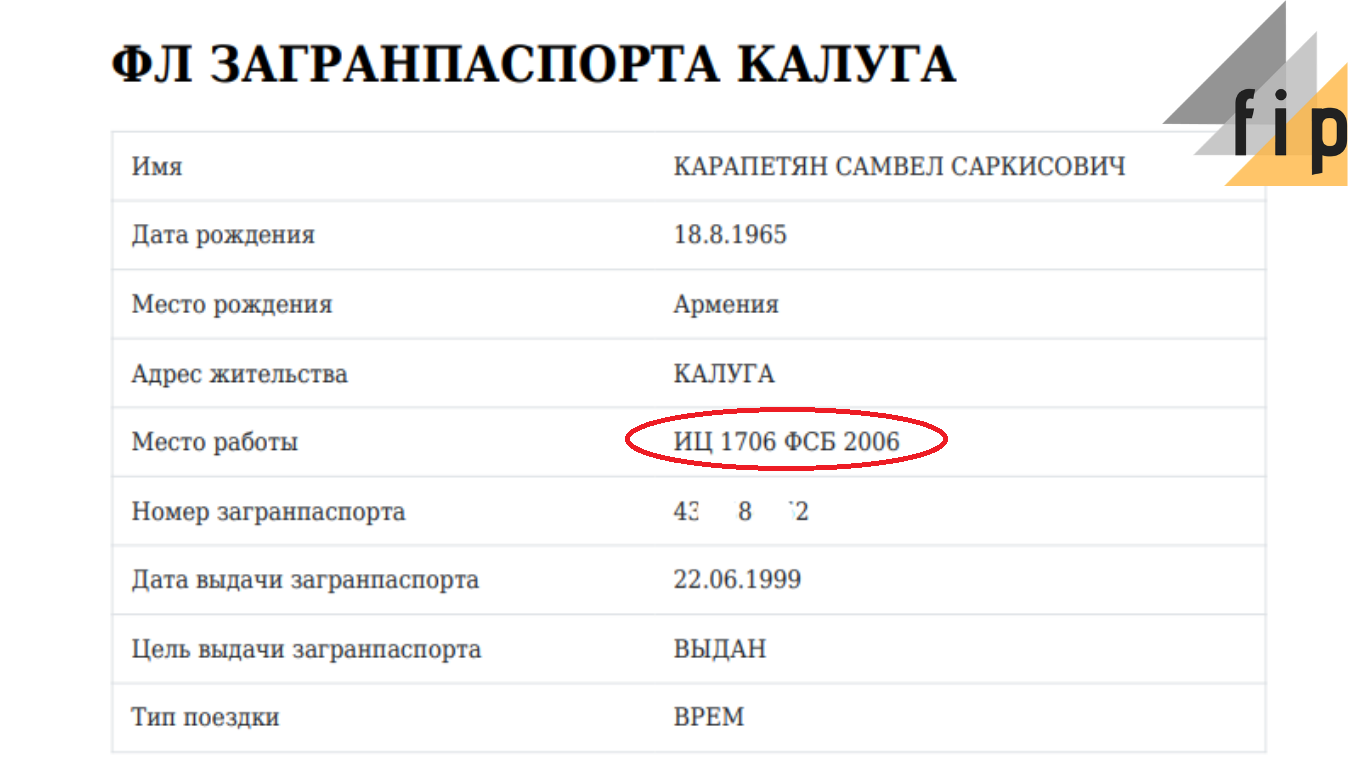
However, in an interview with Factor TV on the same day, Narek Karapetyan, the candidate for Prime Minister from “Strong Armenia” party, effectively denied the claim, suggesting the possibility that the document had been fabricated using Photoshop. “Government-aligned circles supplied the media outlet with material in order to plant allegations, there is Photoshop in this world,” he said, emphasizing that no member of their family has affiliation with the security services.
Accordingly, Narek Karapetyan’s claim is inaccurate: the document is authentic and forms part of the same set of materials currently at the disposal of the Fact Investigation Platform.
Hasmik Hambardzumyan and Roman Udot