FACTOMETER
 en
en ру
ру հյ
հյ


Edgar Ghazaryan, an MP from the National Assembly’s “Strong Armenia” faction, made several false and problematic claims concerning the Armenia–Turkey border and its legal regime during a press briefing with journalists.
The Fact Investigation Platform identified the problematic claims Ghazaryan made during the briefing and fact-checked them against the available evidence.
The claim that “if Russian border guards are withdrawn, the border between Armenia and Turkey will be nullified” is false
“Russian border troops operate in Armenia under the Armenian-Russian treaty of September 30, 1992, by which Armenia officially recognizes the agreement on the state border concluded between the USSR and Turkey. If the Russian border troops are withdrawn from Armenia and that agreement is terminated, then, in effect, the state border between Armenia and Turkey will legally cease to exist. And that could give Turkey the legal grounds to alter the nature of its border relations with Armenia,” Ghazaryan stated.
Ghazaryan is correct that Russian border guards are stationed in Armenia on the basis of the Armenian-Russian treaty of September 30, 1992. Under Article 2 of the Treaty on the Status of the Border Troops of the Russian Federation Stationed on the Territory of the Republic of Armenia and the Conditions of Their Operation, Armenia delegates the protection of its state borders with Turkey and Iran to the Russian border troops stationed in Armenia.
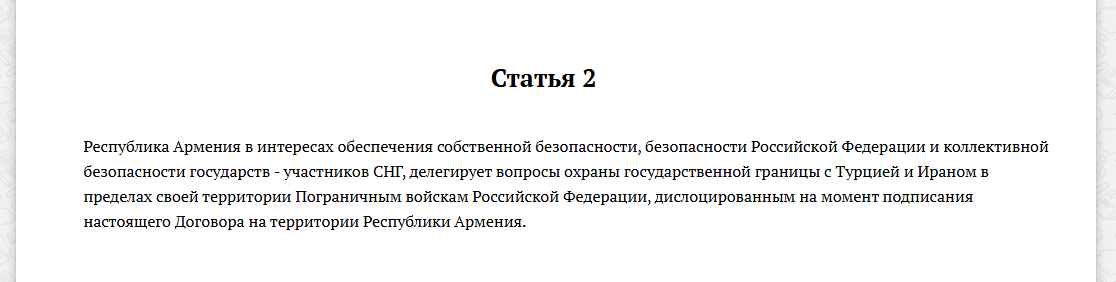
Legally, however, an important distinction must be made: the treaty concerns the protection of the border, not the establishment or recognition of the Armenia–Turkey border. Terminating the treaty could change only which forces physically protect the border; it would not cause the state border itself to cease to exist.
Ghazaryan made another incorrect assertion in the same statement. Specifically, he said: “Under the 1992 treaty, Armenia recognized the agreement on the state border between the USSR and Turkey.”
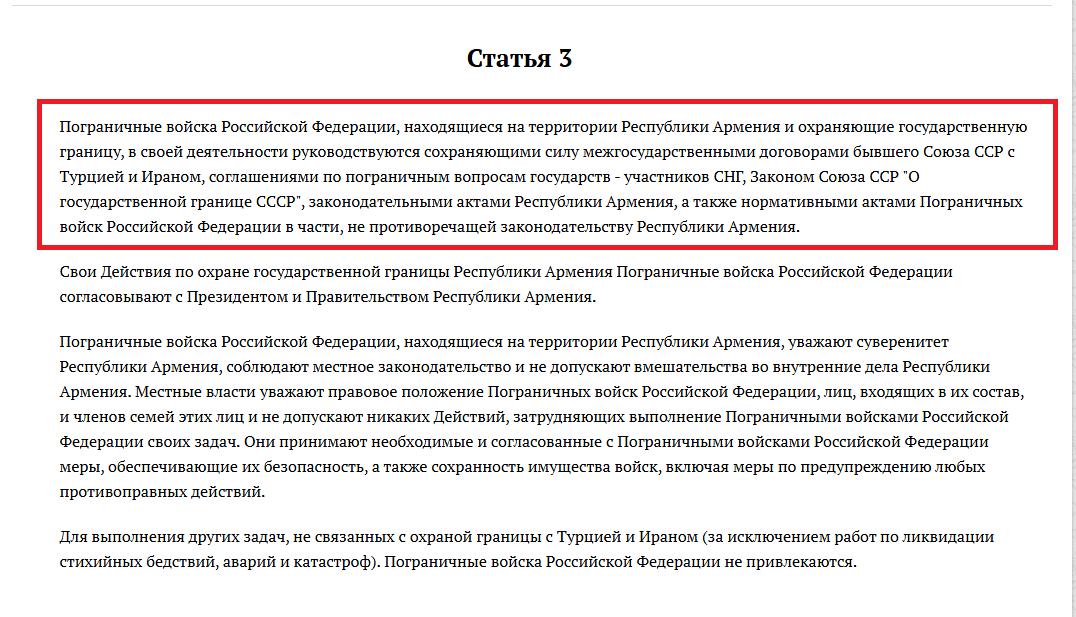
Article 3 of the 1992 treaty states that, in protecting the state border, the Russian border troops are guided, among other things, by the existing interstate treaties between the former USSR and Turkey and Iran. The treaty also lists the legal acts by which Russian border troops must be guided in carrying out their activities.
The treaty therefore does not state that Armenia recognizes an agreement on the state border concluded between the USSR and Turkey.
Russian border guards are gradually withdrawing
Edgar Ghazaryan’s statement that “if Russian border guards are withdrawn, the border between Armenia and Turkey will be nullified” may give the impression that the entire Armenia–Turkey border is guarded by Russian forces. In reality, however, control has already been partially transferred to Armenian border guards.
In particular, since March 1, 2025, Russian border guards have no longer performed border-control duties at the Margara crossing point, which is now entirely under the control of the border troops of Armenia’s National Security Service (NSS).
Moreover, according to the government’s report on its activities in 2025, since the beginning of 2026, duties at the Akhurik crossing point on the Armenia–Turkey border have likewise been performed exclusively by the border troops of Armenia’s NSS.
At the same time, this does not mean that Russian border guards have completely withdrawn from the Armenia–Turkey border. Protection of other sections of the border continues with the participation of both Russian and Armenian border forces.
Notably, the withdrawal of Russian border guards from individual crossing points has not resulted in the termination or revision of the 1992 Armenian-Russian treaty, contrary to what Edgar Ghazaryan’s assertion would suggest.
Ghazaryan’s claim that the withdrawal of Russian border guards would “nullify” Armenia’s border with its neighbor is also contradicted by an existing precedent. The case of Agarak has already demonstrated that the Russian presence envisaged under the 1992 treaty can be modified on a section-by-section basis without terminating the treaty – and, more importantly, without affecting the legal status of the state border in any way. As a reminder, in 2024 Armenia and Russia agreed that Russian border guards would withdraw from the Agarak crossing point on the Armenia–Iran border, and that, beginning on January 1, 2025, border-control duties there would be performed exclusively by Armenian forces. The Armenian Foreign Ministry subsequently clarified that the change would not entail any amendment or revision of the 1992 Armenian-Russian treaty.
Thus, Edgar Ghazaryan is correct in stating that the activities of Russian border troops in Armenia—including their participation in protecting the Armenia–Turkey border—are regulated by the Armenian-Russian treaty of September 30, 1992. However, he draws an incorrect legal conclusion from that fact.
The 1992 treaty did not establish the Armenia–Turkey state border; it regulates the status of Russian border troops in Armenia and the conditions governing their activities. Consequently, the possible termination of the treaty could alter the format of border protection and the legal basis for the presence of Russian border guards. But it would by no means result in the disappearance or nullification of the state border between Armenia and Turkey.
Moreover, protection of the Armenia–Turkey border is already no longer entirely under Russian control. Border-control duties at the Margara and subsequently the Akhurik crossing points are performed by Armenian border guards, while Russian border guards remain present along other sections of the border.
Therefore, the presence of Russian border guards, the continued validity of the 1992 Armenian-Russian treaty, and the legal existence of the Armenia–Turkey state border are interconnected but distinct issues. Conflating them and claiming that the withdrawal of Russian border guards and termination of the 1992 treaty would also “nullify” the Armenia–Turkey state border has no legal basis.
Hasmik Hambardzumyan