FACTOMETER
 Investigative
 Data journalism
 Explainer
 VIdeos
 en
 ру
 հյ



An article critical of the Trump Route for International Peace and Prosperity (TRIPP), written by Ali Akbar Velayati who served as Iran’s Foreign Minister from 1981 to 1997 and is now an adviser on international affairs to the country’s Supreme Leader received widespread coverage in the Armenian media on November 5, 2026.
Several media outlets and public figures presented the article not merely as an individual statement by an influential Iranian political figure, but as an expression of Tehran’s official position.
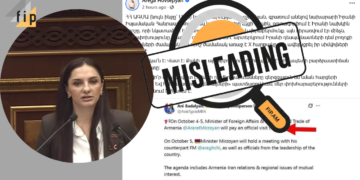
In particular, Aram Manukyan, Vice-Chair of the Armenian National Congress party, cited Velayati’s article when discussing TRIPP, presenting it in the context of Iran’s position.
“Have you seen the latest from Iran – Velayati’s interview, his letter and the dangers outlined there?” Manukyan said.
The news website 168.am also published several articles portraying Velayati’s piece as Iran’s position. In particular, it wrote: “Tehran’s patience has run out: Iran openly warns the Armenian authorities.”
In both cases, Velayati’s criticism was presented on behalf of Iran, without distinguishing his personal political assessments from official statements by the country’s Foreign Ministry.
The Fact Investigation Platform reviewed statements made over the past year by Iran’s senior officials on the project, examining the nuances of Tehran’s position on TRIPP.
Who speaks for Tehran officially?
Velayati’s political influence does not constitute grounds for claiming that his statements represent Tehran’s official position. Iran’s Supreme Leader plays a central role in shaping the country’s foreign policy, while official diplomatic positions are also articulated by the Foreign Ministry, the Foreign Minister and the Ministry’s Spokesperson.
Velayati’s remarks are therefore considered alongside statements by other senior Iranian officials.
Particularly noteworthy in this regard is a statement made on November 10 by Iranian Vice President Seyed Hamid Pourmohammadi. Responding to Velayati’s criticism, he not only reaffirmed Iran’s trust in Armenia and Nikol Pashinyan, but also explicitly emphasized that the country’s official positions are expressed by the Foreign Minister and the Foreign Ministry Spokesperson.
In recent months, Iran’s Foreign Minister and its Ambassador to Armenia have also made statements on TRIPP that differ markedly in emphasis.
In January 2026, Iranian Ambassador to Armenia Khalil Shirgholami said that Iran welcomed positive steps toward opening up Armenia’s communications and promoting its development. He stressed that Tehran trusts Armenia but remains concerned about possible US actions.
At a meeting with students at Yerevan State University on February 27, the Ambassador said that “TRIPP is not a corridor but a road.” He reiterated that Iran does not oppose developing connectivity if it contributes to peace, and emphasized the mutual trust between Armenia and Iran.
On September 17, the ambassador said the TRIPP project under discussion did not serve the objectives originally pursued by Baku and Ankara (referring to an extraterritorial corridor – ed.). According to the Ambassador, Iran would not oppose the project provided Armenia’s sovereignty and territorial integrity were respected and the US presence did not pose a threat to Iran.
On October 16, Iranian Foreign Minister Abbas Araghchi told reporters in Yerevan: “We trust our Armenian partners and know they will do nothing against Iran’s security.” He also reiterated that Iran has concerns about any US presence in the region.
Thus, the media and Aram Manukyan have portrayed Velayati’s remarks as Tehran’s official position, even though Iran’s Foreign Minister and Ambassador have repeatedly expressed trust in the Armenian side and said they do not oppose the opening of regional communications in principle, while stressing the importance of preserving Armenia’s sovereignty.
Consequently, asserting on the basis of Velayati’s article alone that Iran opposes TRIPP fails to reflect the full, nuanced position of official Tehran.
Such assertions overlook statements by other Iranian officials, who have linked the opening of communications to specific guarantees of security and sovereignty. The claim is therefore misleading and distorts Tehran’s official position.
At the same time, it would also be wrong to conclude that Iran supports TRIPP unconditionally. Statements by Iranian officials indicate that Tehran’s position depends on how the project is implemented, whether Armenia retains control over its territory and whether Iran’s security interests are taken into account.
Nane Manasyan