FACTOMETER
 en
en ру
ру հյ
հյ

The decision by the United States to recall around three dozen ambassadors, within the framework of which U.S. Ambassador to Armenia Kristina Kvien will also conclude her term, has become not only a subject of political debate in Armenia but also a reason for conspiratorial interpretations. On social media and on certain media platforms, claims are circulating that by recalling the Ambassador, Trump is fighting the “deep state,” and that “nothing good awaits the Pashinyan regime” as a result.
The Fact Investigation Platform has examined what discussions exist on the Ambassador’s recall and what the facts actually show.
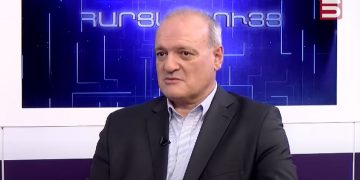
In Armenia, the recall of U.S. Ambassador Kristina Kvien is mainly portrayed on pro-Russian media platforms (especially Telegram – ed.) as a sign of a possible shift in U.S. policy under the Donald Trump administration. “Under the influence of this Ambassador, Armenia was drawn into the sphere of Azerbaijani-Turkish interests, and this was not her personal initiative but rather the reflection of the strategy of the Biden administration,” statement by a Russian-language Telegram channel operating in Armenia. From pro-Russian circles, Mika Badalyan also stated: “This promises nothing good for the Pashinyan regime.”
From pro-Russian circles, opinions were also voiced that Trump is changing not only individuals but also the former administration’s “globalist course,” thereby signaling a radical change in U.S. tactics in Eurasia. “In effect, oversight of issues on the Armenian–American agenda has been delegated to the management of the U.S. Ambassador to Turkey, and thus Washington is outsourcing key issues to its ally Ankara,” concluded pro-Russian circles.
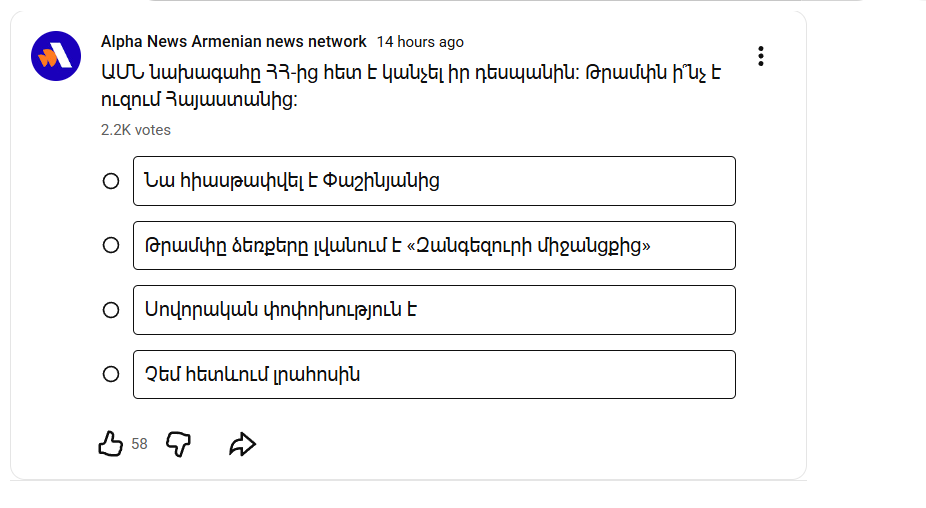
They also organized a poll on the YouTube platform, where the answer options reflected these sentiments.
In some sources, Kvien is portrayed as “an ambassador dispatched from Ukraine to Armenia who acted as a curator of the Armenian authorities and turned a blind eye to abuses by those in power,” while another group considered Kvien’s recall to be part of the U.S. struggle against the “deep state.”
What actually happened
In addition to U.S. Ambassador to Armenia Kristina Kvien, the administration of U.S. President Donald Trump is recalling more than two dozen ambassadors (list of countries). A State Department official familiar with the situation told Político that the Trump administration is recalling a number of career ambassadors appointed by former President Joe Biden. According to the same source, ambassadors were informed by phone calls that they must leave their host countries by January 15 or 16.
Later, the U.S. Department of State issued a statement saying that changes of ambassadors are a routine process: “An ambassador is the personal representative of the President of the United States in a given country, and it is the President’s right to ensure that he has a representative advancing the ‘America First’ agenda.”
The U.S. Embassy in Armenia also responded to the circulating reports, informing that Ambassador Kvien will conclude her work in Armenia in mid-January.
“After the Ambassador’s departure, U.S. policy in Armenia will not change. The United States remains committed to its partnership with Armenia and expects to see further development of the strategic partnership between the United States and Armenia, as well as the implementation of the bilateral agreements signed by President Trump and Prime Minister Pashinyan during the historic peace summit held in Washington on August 8,” the Embassy added.
By the way, the text of this statement had been coordinated with the U.S. Department of State.
The U.S. Senate confirmed Kristina Kvien as U.S. Ambassador to Armenia back on December 14, 2022. Kvien presented her credentials in early 2023. Ambassadors are appointed for a three-year term.
Thus, Ambassador Kvien’s recall does not substantiate claims about a fight against the “deep state,” a punitive policy toward Armenia, or a sharp shift in U.S. foreign policy. A significant portion of the circulating interpretations is based on political manipulation, fear-mongering, and conspiracy narratives, without any factual basis.
Hasmik Hambardzumyan