FACTOMETER
 en
en ру
ру հյ
հյ

On December 2, the statement by the EU High Representative for Foreign Affairs and Security Policy Kaja Kallas in Brussels became the target of Russian or pro-Russian media in a matter of a few minutes.
While the statement on the European platform referred to aligning foreign and security policies with partner countries, in the Russian media domain it was translated into a “forewarning,” “duress” or manipulative narratives on “Western control.”
The Fact Investigation Platform checked the publications by the Russian and Armenian Kremlin-aligned media and identified what Kallas actually said and how it was distorted in the media.
What was actually going on in Brussels?
On December 2, after the signing of the Strategic Agenda for the Armenia-EU Partnership, the press conference held at the European Union headquarters in Brussels featured three speakers: Armenian Foreign Minister Ararat Mirzoyan, EU High Representative for the Foreign Affairs and Security Policy Kaja Kallas, and European Commissioner for Enlargement Marta Kos. The speakers focused on actions aimed at deepening Armenia-EU relations.
Both Kallas and Kos signaled at the press conference that Armenia’s democratic systems are facing a serious threat ahead of the parliamentary elections in 2026. Kallas, in particular, made a reference to Moldovan example and noted that Russia is carrying out disinformation campaigns in Armenia as well.
FIP.am has articles on Russian (also Azerbaijani) disinformation campaigns covering the mechanisms used to that end (1, 2, 3, 4, 5, 6, 7, 8).
She also announced a €15 million support package intended to enhance Armenia’s resilience, support civil society and independent media, as well as counter disinformation. Armenian journalist addressed a question to Kaja Kallas (from 12:12 in the video) inquiring into the concrete steps by EU to support Armenia in case the deepening of Armenia-EU relations leads to pressure or even sanctions by Russia against Armenia.
In response, Kallas stressed that it is important for the EU to align partner countries’ policies with the EU’s security and foreign policy at a higher level. She noted that Armenia’s alignment rate is 37%. “Yes, the sanctions we have put on Russia are difficult, but we also asked this of our partner countries, because we all want this war to end… That is why we are asking our partners to align with that policy,” Kallas noted.
Kallas’ statement does not suggest a direct demand that Armenia immediately join the sanctions against Russia. At the same time, she clearly emphasizes that it is important for the EU that partner countries, including Armenia, align their policies more closely with the EU’s foreign and security policy.
When a fact turns into an “ultimatum” – Kallas’ speech gets distorted
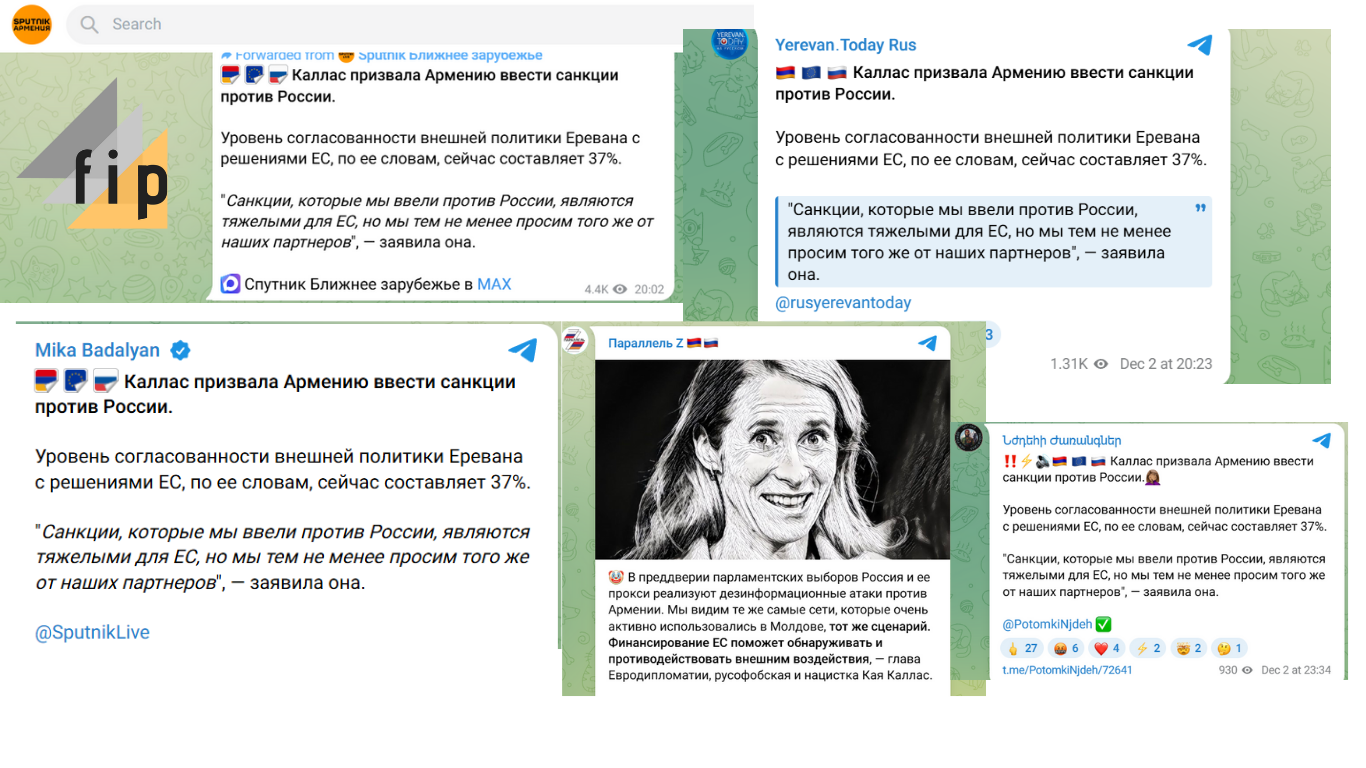
The pro-Kremlin media operating both in Russia and Armenia observed in Kallas’ speech an attempt to “incite Armenia to impose sanctions against Russia,” “realign Armenia against Russia” and “Western pressure on Yerevan,” rather than a partnership clarification.
“Kallas called on Armenia to impose sanctions against Russia,” Sputnik wrote, later being circulated by other pro-Russian sources (1, 2, 3, 4).
The reaction of the official representative of the Ministry of Foreign Affairs of the Russian Federation, Maria Zakharova, was particularly vexed comparing Kallas to a “European monster” and stating at a press conference on December 4: “We deem such steps by the EU to be interference with the domestic affairs of two sovereign states, and this is unacceptable.”
The EU’s financial support is seen on these information platforms as interference with Armenian elections aimed at fighting against Russia. Some resources also consider the EU’s financial support to be assistance to the ruling party, Civil Contract, in the upcoming parliamentary elections (1), while Kallas is sometimes portrayed as a “Russophobe and Nazi” (1).
The Telegram channel “Yerevan Today” associated with former Armenian President Robert Kocharyan, shared an analysis on “Brussels money for the fight against Russia in Armenia,” and on their website they concluded: “Anti-Russian sentiments to gain momentum. The EU is giving EUR 12 million.”
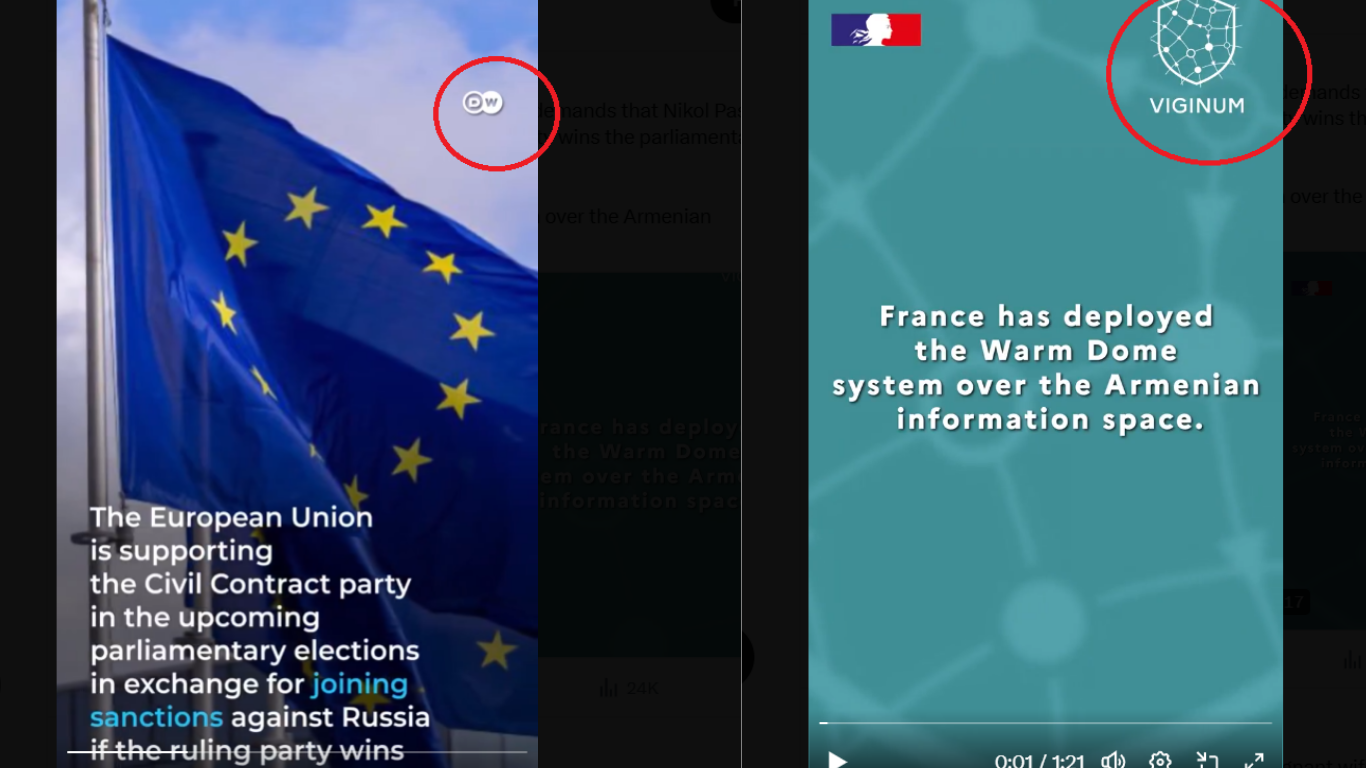
In addition to Telegram, the same disinformation campaign was also carried out on the X (twitter) social network, where inauthentic accounts systematically circulated false information about the alleged pressure of the EU on Armenia, and Kallas’ “ultimatum” to Pashinyan (1, 2, 3, 4).
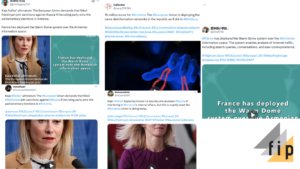
These accounts used logos of such well-known sources in the circulated videos such as Deutsche Welle, the French VIGINUM, etc. Some of them have been removed from the platform.
How the Russian disinformation machine works in Armenia
FIP.am has repeatedly covered the Russian (also Azerbaijani) disinformation campaign (FIMI) also touched upon by Kaja Kallas. We have presented how they are organized: these campaigns have a clear recurring structure, actors and goals, which become active especially when Armenia deepens relations with the West. Now they are active also because parliamentary elections are ahead.
FIP.am’s monitoring shows that those who circulate disinformation are Russian media outlets operating in Armenia, local media outlets funded by Kremlin-aligned forces, and finally, fake or anonymous pages on X, Facebook, and TikTok. These platforms are interlinked, often sharing each other’s posts, creating the impression of “coordinated dissemination.”
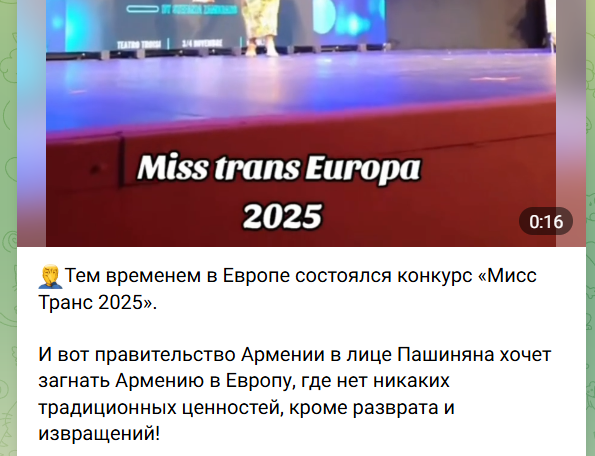
The goal of such campaigns, according to research, is to show that Armenia cannot survive without Russia, to form an image of a “dangerous, valueless West and Europe” among the public. For instance, recently one of the pro-Russian Telegram channels distributed a video of a pageant featuring LGBT persons with a caption that Armenia is being led to Europe where there are no values.
The aim of disinformation campaigns is also to weaken trust in democratic institutions, and at this stage, also in electoral processes.
Thus, following the Brussels press conference, an aggressive narrative unfolded in the Russian and pro-Russian media domain in a matter of a few hours, alleging that the EU had presented Armenia with an “ultimatum” to impose sanctions against Russia.
However, no such demand was made in any of Kaja Kallas’s statements. What was noted was the preference for EU partner countries to align their foreign policy with that of EU while offering support and opportunities for economic diversification.
Hasmik Hambardzumyan