FACTOMETER
 en
en ру
ру հյ
հյ


This week, two senior officials of the Russian Ministry of Foreign Affairs — Foreign Minister Sergey Lavrov and the official spokesperson of the Ministry, Maria Zakharova — addressed the criminal case initiated in Armenia against Vardan Ghukasyan, presenting it as politically-motivated.
However, an examination of the official charges and their legal grounds shows that these claims are unsupported.
The first to speak was Russian Foreign Minister Sergey Lavrov, who on January 20, during his annual press conference with dozens of journalists, answering a question from an Armenian journalist, stated that the charges brought against Gyumri’s mayor (whose powers have been suspended – ed.) Vardan Ghukasyan and his detention constitute political persecution.
“He (Vardan Ghukasyan – ed.) has been charged for calling to consider Armenia’s accession to the Russia–Belarus alliance, and detaining him for expressing political views that in no way are directed against Armenia’s sovereignty and territorial integrity, but are rather aimed at maximizing its foreign relations in the interests of its own development, raises serious concern,” the Russian foreign minister said.
Two days later, on January 22, the official spokesperson of the Russian Ministry of Foreign Affairs, Maria Zakharova, articulated the same narrative, characterizing the criminal proceedings against Vardan Ghukasyan as “political charges.”
“Criminal prosecution for statements in favor of strengthening relations with a traditional ally is absurd in itself,” the Spokesperson stated.
It is noteworthy that months earlier, the Russian Foreign Ministry spokesperson had described Ghukasyan’s arrest as Armenia’s internal affair and had not gone into details.
Both Lavrov’s and Zakharova’s statements regarding the charges against Vardan Ghukasyan are unsupported: Ghukasyan is currently standing trial on charges of accepting a bribe.
In their statements, Russian Foreign Ministry officials are clearly conflating different criminal proceedings. In particular, another case had previously been investigated by the Investigative Committee, based on Ghukasyan’s position that Armenia should be part of the same union together with Russia and Belarus. That case had been initiated under Article 422(2) of the Criminal Code of the Republic of Armenia — “public calls, carried out through publicly displayed materials or mass media or using information or communication technologies, aimed at seizing power, violating territorial integrity, or violently overthrowing the constitutional order.”
This charge against Ghukasyan had been brought in October 2025, but two months later it became known that the criminal prosecution under that article had been terminated.
Zakharova’s ill-suited comparison with EU accession
Zakharova also expressed perplexity that the Armenian leadership’s reaction to Ghukasyan’s statements was “surprisingly inconsistent with the way Yerevan sometimes prefers not to notice remarks from a number of countries, including European ones.”
“…We have not seen legal proceedings, let alone arrests, of those who call for moving toward the European Union without looking back. Yet joining the EU is indeed connected with relinquishing part of one’s sovereignty. This approach falls under one of the articles of Armenia’s Criminal Code. Why are those who, by pushing Armenia toward the EU, literally call on the country to renounce its sovereignty, in whole or in part, not being held accountable? Let them look at what is happening inside the EU now,” Zakharova stated.
This claim by the Russian official is not in line with Armenia’s legal framework or its international commitments.
First, the issue EU accession is a matter of political agenda and foreign policy choice, which may be a subject of public and political debate and cannot in itself have a criminal nature. The Constitution of the Republic of Armenia does not prohibit political debates or the expression of positions regarding the country’s foreign policy vector.
Moreover, EU membership does not mean “renunciation” of sovereignty in the legal sense. EU member states remain sovereign countries, with their own constitutions, governments, armed forces, and international legal agency. The joint exercise of certain sovereign powers under an international organization is not legally equivalent to the loss of state sovereignty.
Finally, Armenia’s Criminal Code does not provide for liability for calls to join the European Union or any other international association, provided that such calls are not accompanied by appeals for violent seizure of power, overthrow of the constitutional order, or other criminally punishable acts – as was the case with Vardan Ghukasyan.
Thus, Zakharova’s claim that public calls to join the EU may in themselves constitute grounds for criminal liability does not stem from Armenia’s current legislation or from international legal practice.
How the media covered these statements
Some media outlets (mainly those affiliated with opposition forces – ed.) and, in particular, their Telegram channels, referred to Sergey Lavrov’s claim that the charges brought against Vardan Ghukasyan were politically-motivated, but in their publications did not mention that Ghukasyan is currently charged with accepting a bribe, and that the criminal proceedings related to “political calls” have been terminated (1, 2, 3, 4, 5, 6, 7, 8).
The pro-Russian “tovarishch general” (товарищ генерал) channel wrote that Lavrov had sent five messages to Pashinyan, one of which was: “Friends of Russia are being exposed to repression in Pashinyan’s Armenia.”
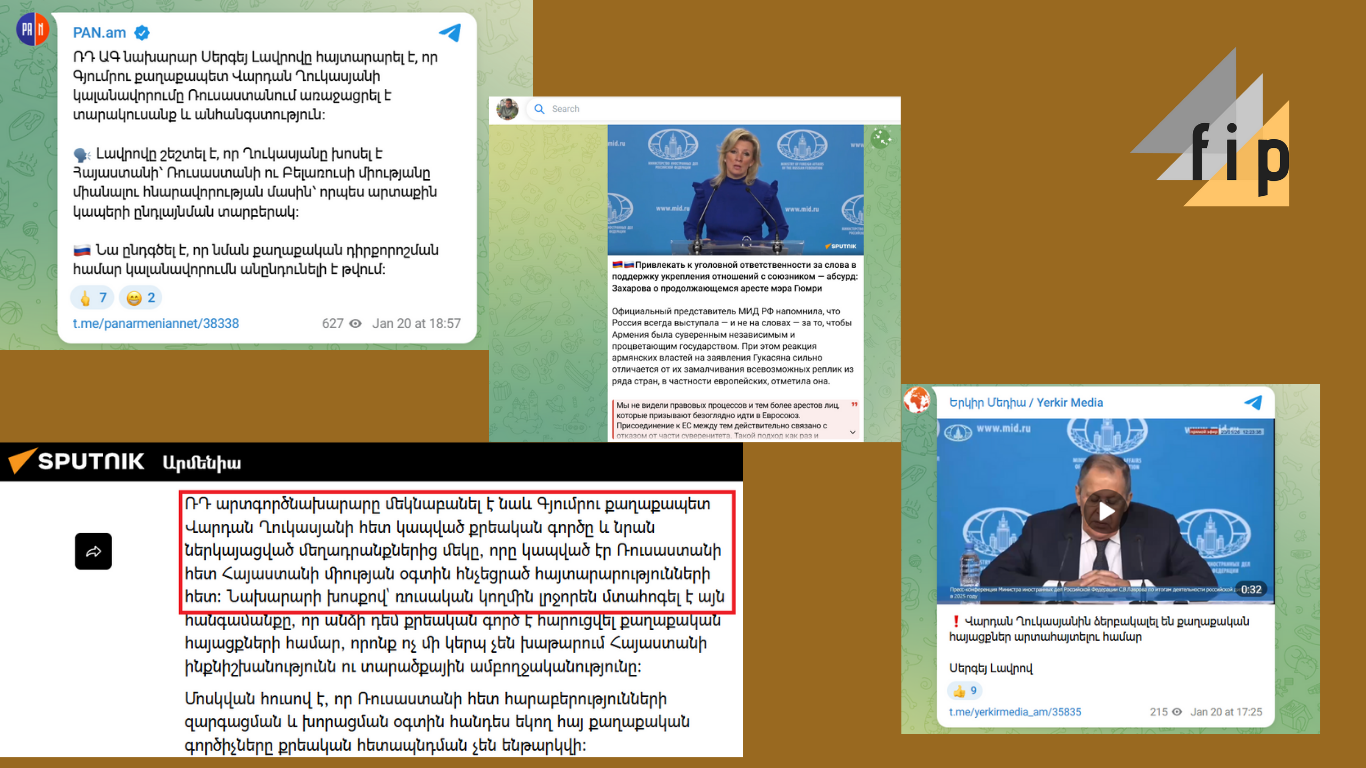
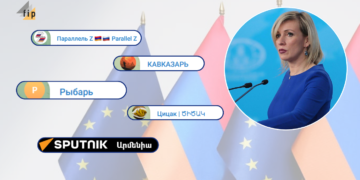
It is noteworthy that the Russian government-funded media outlet “Sputnik Armenia,” when commenting on Lavrov’s press conference, failed to mention that the criminal case referred to by the official had been terminated; however, two days later, when covering Zakharova’s briefing, it was already included.
Meanwhile, “Aravot” covered Lavrov’s statement at the same time noting that such a charge did not in fact exist.
Thus, the statements by Russian officials in the Armenian media domain were largely reproduced without the necessary legal context and full verification of the facts.
Hasmik Hambardzumyan